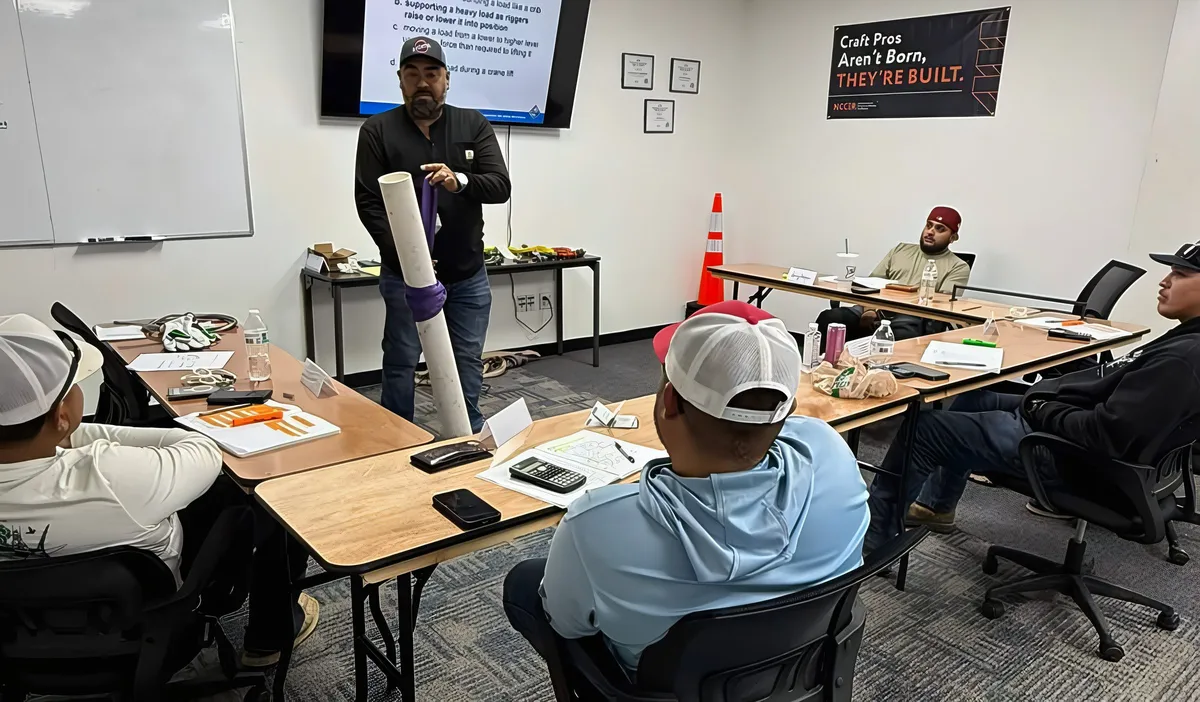
Instructor demonstrating a sling hitch on a load during an Advanced Rigger class

NCCER Certified Advanced Rigger

Advanced RiggerCertification

Four days of classroom and hands-on rigging in Portland, TX, then a written and practical test-out in the same building. Day, night or one weekend. $200 holds your seat.

Course price$1,000 $1,700
Holds your seat$200
Length4 days
CredentialNCCER Advanced Rigger

01The Course

What The
Course Covers

The Advanced Rigger course is for anyone who rigs loads for a living, or wants to. New hires get the foundation; experienced hands get the card that proves what they already know. You learn to plan a lift, calculate load weight and center of gravity, pick and inspect the right sling and hardware, control the load, and signal the crane, then you test out in our accredited testing room.

What you'll learn

  • Advanced rigging principles and lift planning
  • Load weight calculations and center of gravity
  • Sling selection, hitch configurations and inspections
  • Rigging hardware: shackles, hooks, spreader bars and below-the-hook devices
  • Load control, tag lines and crane hand signals
  • Written and hands-on practical test-out on the last day

02How We Teach It

Shown, Not
Just Told.

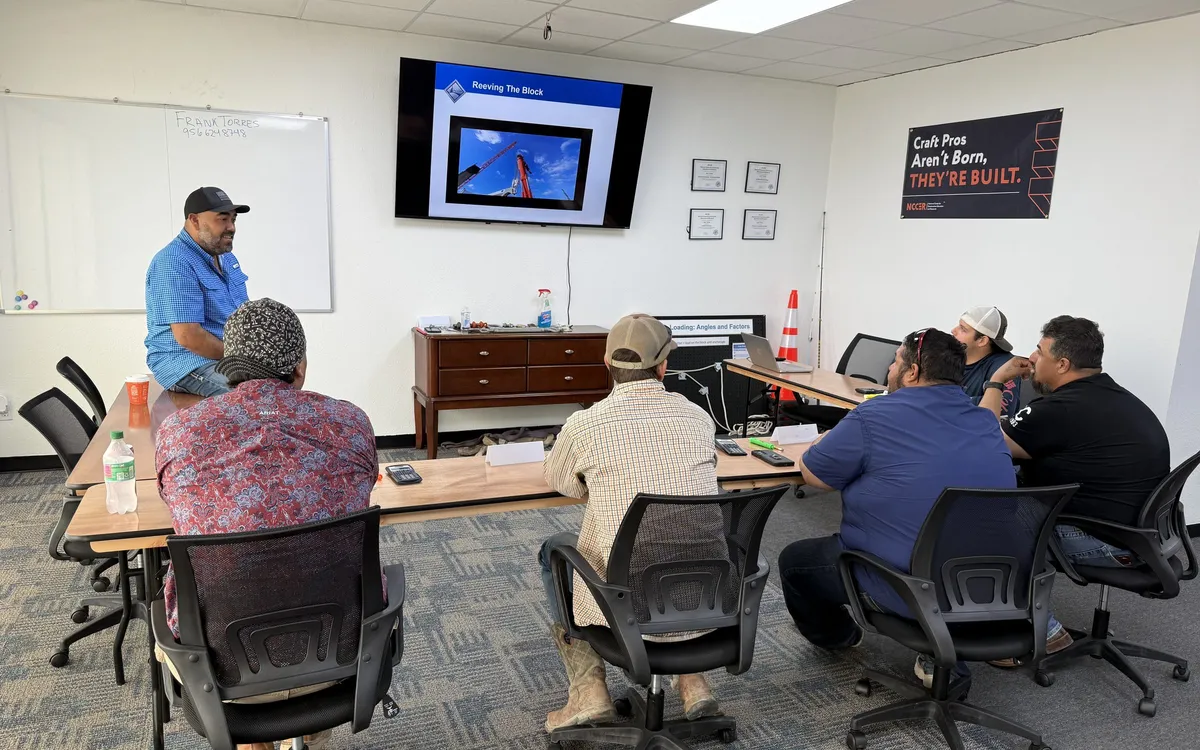
We understand everyone learns differently, which is why we run plenty of visual scenarios and demonstrations: boom deflection, side loading, shock loading, block factors, the two most important knots in rigging and much more, all to help you understand the information being taught.

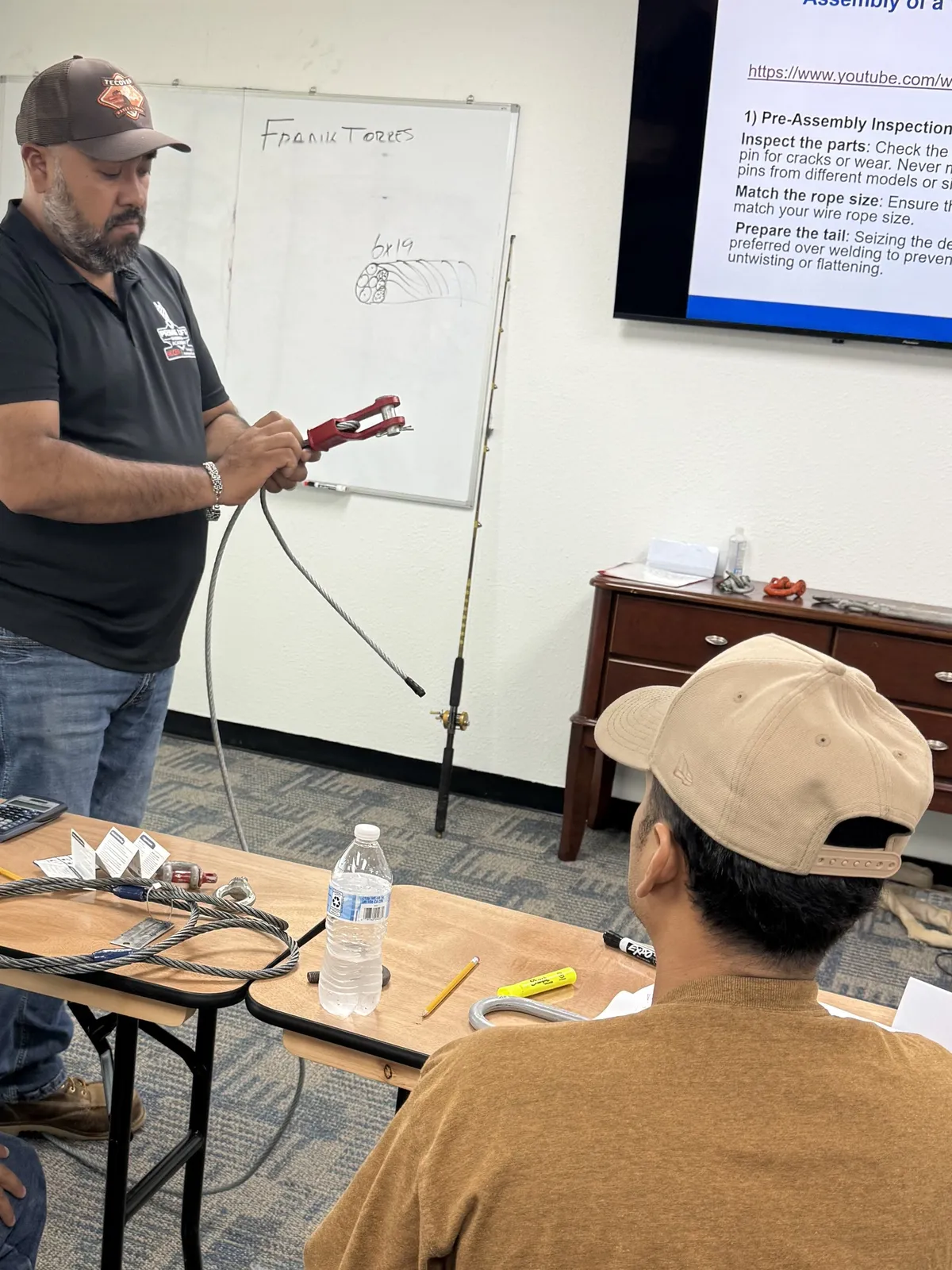
Instructor Frank Torres showing a class how to assemble a terminator wedge socket on wire rope
Assembling a terminator (becket)
01

A Termination Is Only As Good As The Assembly

A terminator, the wedge socket that anchors the end of a wire rope, gets assembled in front of the class. The parts come apart, get inspected for cracks and wear, and go back together in order.

The details are the lesson. Never mix wedges, sockets and pins across different models or sizes. Match the wedge and the socket to the rope you are actually using. Seize the dead end instead of welding it, so the strands cannot untwist or flatten. Miss one of those and the termination becomes the weakest point in the lift.
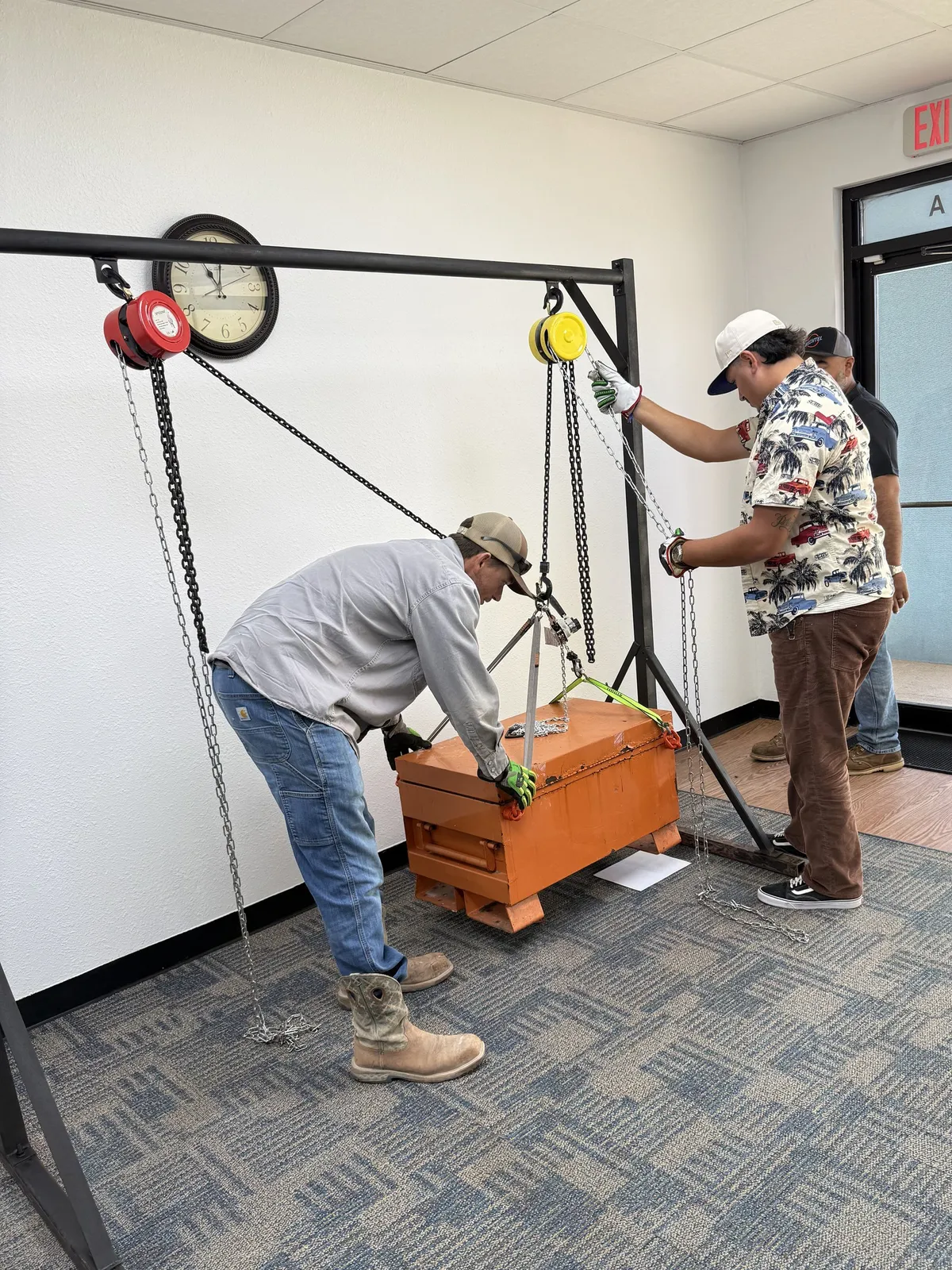
Two students communicating with each other to drift a load across a gantry with chain hoists
Drifting a load with chain hoists
02

Two Hoists, One Load, One Conversation

Drifting a load means moving it sideways: one hoist pays out while the other takes up, and the load walks across the span. Here two students run opposite hoists on the same load and have to keep it under control between them.

The rigging is the easy half. The hard half is two people agreeing out loud on what happens next, which is exactly what goes wrong on a real job when nobody is talking.

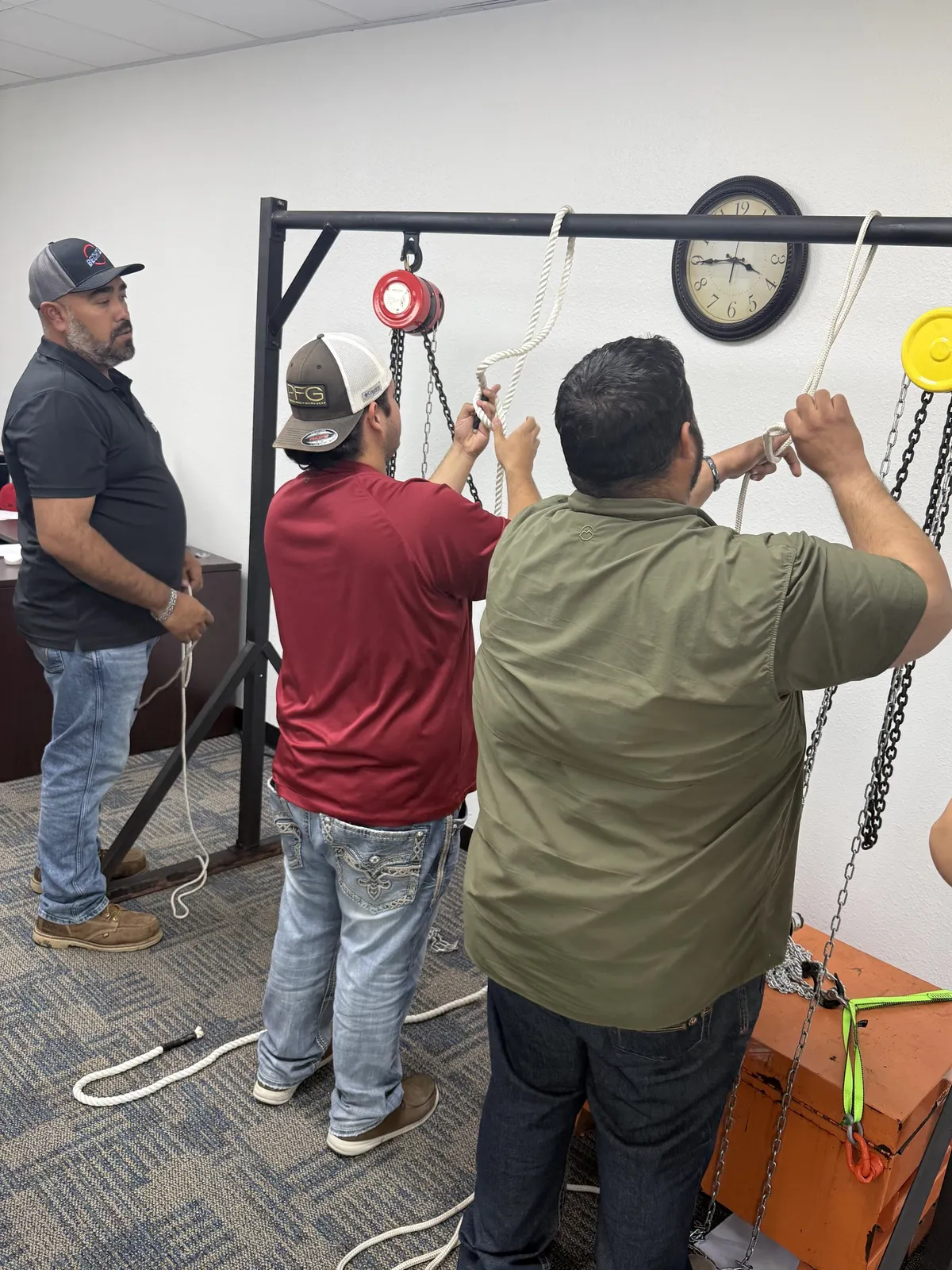
Students tying the two most important knots in rigging on the training gantry
The two most important knots
03

The Two Knots You Will Actually Use

Every rigger ends up with a short list of knots that carry almost all of the work, and two of them do most of it. Students tie them on the gantry with the same rope and hardware they will see on a job, not on a desk with a length of string.

Once you have tied one correctly with your own hands a few times, you stop having to remember how it goes.

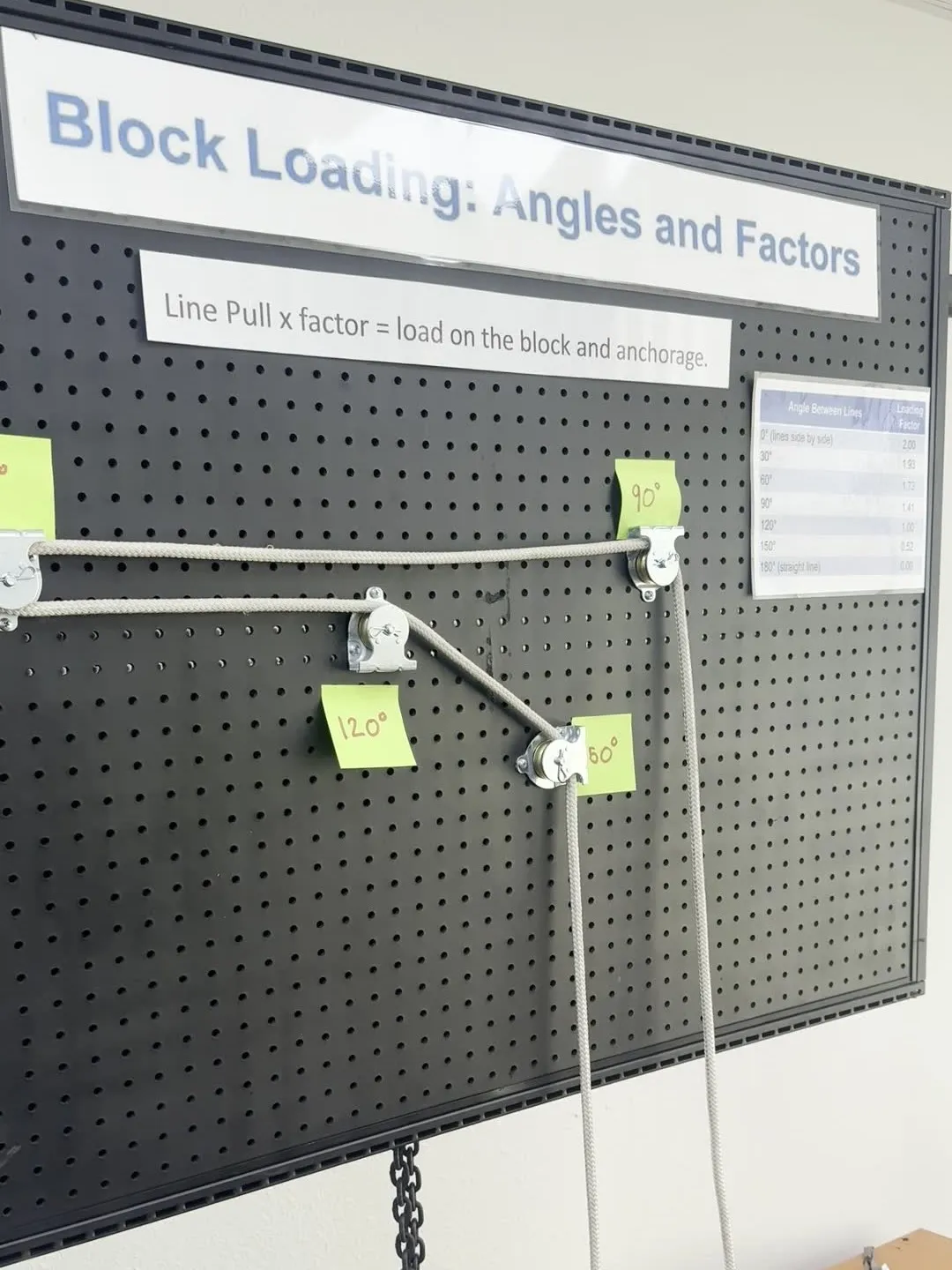
Block loading demonstration board showing line pull angles and the loading factor each one produces
Block loading: angles and factors
04

The Angle Is The Whole Story

One line on the board carries the whole idea: line pull times a factor equals the load on the block and its anchorage. Change the angle between the two lines and the factor changes with it.

The same rope is set at 60, 90 and 120 degrees so the difference stops being a formula on a page. Two lines running side by side put twice the line pull on the block. Open them to ninety degrees and it falls to about 1.41. Open them out into a straight line and the block carries almost nothing at all.

Boom deflection, side loading and shock loading get the same treatment. If a thing can be shown instead of described, it gets shown.

03Schedules

Built Around
Your Shift.

Every format ends the same way: a written and hands-on test-out in our accredited testing room, and a credential on the NCCER Registry.

01 Weekday Day Class Mon – Thu · 8:00 AM – 2:00 PM

Four days. Starts every Monday.

02 Weekday Night Class Mon – Thu · 6:00 PM – 11:00 PM

Four nights. Built for day-shift crews.

More about this format
03 3-Day Weekend Express Fri – Sun · 8:00 AM – 5:00 PM

Done in one weekend. Starts every other Friday.

More about this format

See Upcoming Dates

04Who It's For

Who Takes
This Course

New hires

No experience required. The course starts from the ground up and you leave with a credential that gets you through the gate.

Experienced riggers

You already know the work. Get the NCCER card that puts it on paper for every contractor and turnaround in the country.

Recertification

NCCER rigger credentials are good for five years. Coming due? See our recertification page.

05The Process

Three Steps To Certified

01

Register & Hold Your Seat

Book online in about two minutes. $200 holds your spot. Bring your photo ID and PPE on day one; pens, notebooks, snacks and drinks are on us.

02

Train Classroom & Hands-On

Real rigging hardware, real load calculations, real crane hand signals. Small classes so you actually get your hands on the gear.

03

Test Out & Get Credentialed

Written and practical assessment right here in our accredited testing room. Pass, and your NCCER credential goes on the national registry.

07Common Questions

Advanced Rigger FAQ

Four days, Monday through Thursday, in either the day class (8:00 AM to 2:00 PM) or the night class (6:00 PM to 11:00 PM). The 3-Day Weekend Express runs Friday through Sunday, 8:00 AM to 5:00 PM.

No. The course is built for both new and experienced riggers. Everything is taught from the ground up, and the hands-on portion uses real rigging hardware.

$1,000 during our current promotion, normally $1,700. A $200 deposit secures your seat and the remaining $800 is due before your class begins. Klarna, Afterpay, Zelle and in-house financing with no credit check are available.

Yes. You test out in our NCCER accredited assessment center and your credential is recorded on the NCCER Registry, which contractors across the country use to verify craft credentials.

Five years from the date it is issued.

A government-issued photo ID for NCCER testing. Come dressed for a work day: safety glasses, gloves, a hard hat and steel-toe boots. Pens, paper, notebooks, snacks and drinks are provided.

All questions

Your Future Starts Here

Building Skills.
Bettering Futures.

Spots are limited and classes fill. Lock your seat in now, start studying early, and come ready to pass.

Call Now Book a Class